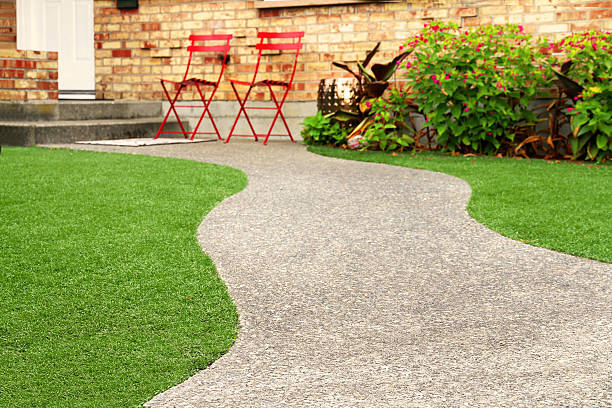
As we’ve seen, artificial grass has become very common and is frequently utilized in place of actual grass. Artificial grass is commonly used where natural grass cannot grow or where maintaining a real grass lawn becomes challenging. Artificial grass is widely employed in residential playgrounds, residences, and other minor purposes in addition to stadiums and sporting facilities.
The Chemstrand Company first developed artificial grass in the 1960s, when it first became popular (known as Monsanto Textiles Company later). ChemGrass, the name of the artificial grass created at the time, would subsequently be changed to AstroTurf.
Materials Used to Make Artificial Grass
Since the raw materials are the primary determinant of the quality and performance of grass, their excellent quality is the most critical component in artificial grass’s performance. Modern manufacturing methods and technological developments have produced artificial grass that resembles the “genuine” thing, actual grass. The grass is long-lasting and resistant to abrasion and wear. It is also UV-resistant, which prevents the color from fading due to harsh weather conditions. Artificial grass has recently been longer, lusher, and softer.
Three materials are primarily used in the production of artificial grass:
- Polypropylene
- Polyethylene
- Nylon
Grass Blades
The fibers used to make artificial grass blades are polyethylene or nylon. Plastic bottles, bags, and other items are often made of polyethylene. Usually, polyethylene is found in solid form. Then it is melted and combined with different dyes and chemicals to produce robust, UV-resistant, and other materials. Additionally, grass blades are made of tiny fibers with an oval or circular cross-section produced from thin nylon sheets using molds. Extremely high-end nylon blades that resemble genuine grass in appearance and feel are extruded from the grass.
Thatch
Polypropylene is commonly used to create thatch layers. The artificial grass is supported and cushioned by this thatch layer.
Turf Backing
High-quality artificial lawns are being built utilizing polyester tie cords as the backing. Using a tufting mechanism, which ensures that the grass blades and thatch are correctly fastened, the grass blades are firmly secured to the turf.
Cushioning
Most of the time, polyester foam or other rubber compounds are used to construct cushioning systems. When making a rubber basis or a base composed of recycled rubber or plastic, rubber tires are occasionally utilized as a raw material. The top fabric panels and the thread used to sew the parts together are often made of premium materials that meet the same criteria for durability, strength, and color retention.
Artificial Grass Manufacturing Process
The artificial lawn’s grass is made using tufting techniques similar to those used to make carpets.
Here are some of the production processes for those who are interested; this may be too much information for regular readers:
- Make sure the bucket is complete with all the supplies required to manufacture the grass blades as soon as possible.
- In addition, chemicals that make grass UV-resistant and shield it from the sun’s harmful rays are added, along with dyes that give “green grass” it’s color.
- The mixture is thoroughly combined before being put into a steel mixer and blended into a transparent liquid with a taffy-like consistency.
- An extruder then processed the viscous liquid. The result is the creation of long, thin strands.
- The thin rope’s strands are carded and spun on a machine to make loose rope. They are straightened and pulled back. They are then turned into yarn and wound around enormous spools.
- The yarn is then heated and twisted into the shape.
- The yarn is then brought to the tufting machine and stored on a bar with an attached reel located behind the tufting machine.
- The needle for tufting, which enters the grass backing and pulls the yarn through as a loop, is then fed the material through an elongate tube. The flat hook or looper holds the nylon loop while moving the backing and needle to the left and backward. Rows are added in this manner until the entire background is covered. The synthetic grass carpet is currently in position.
- The artificial grass carpet is put out with a latex covering underneath. Each mat and its backing are rolled into a machine that presses and seals the two together. Latex is put to support to increase its effectiveness even more.
- After that, the grass is used to cure the latex under the heat lamp.
- A machine that runs over the grass carpet removes any remaining grassy strands.
- After that, the carpet is rolled into lengths and sent for packing. The retailer receives it next.
Artificial grass is being produced using far more modern technologies. The most modern artificial turfs are created from high-quality materials treated with chemicals to make them UV and water-resistant. They are perfect for a wide range of large and small applications since they are soft, less abrasive, and highly comparable to genuine grass.