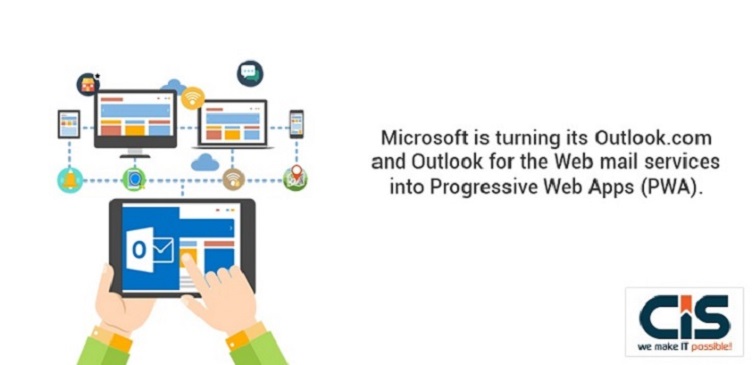
Almost a year ago or so all of us heard that Microsoft Technology Associate is planning to change or modify all of their products and services into PWA that is Progressive Web Apps. At that time probably none of us expected that this kind of modification will happen in the near future, but it did. Up until now, hardly anyone would have thought that the creator of asp.net development services, Microsoft will make these changes so quickly and efficiently.
Recently, Microsoft disclosed its plan of action that it is converting Outlook.com as well as Outlook into PWAs or Progressive web apps for Webmail services.
When this happens, each and every user of Outlook will be able to install the web application on their Windows, Chrome OS, macOS and on any other platform that supports Progressive Web Apps.
What exactly does Progressive Web Apps mean?
The PWAs are nothing much but a fine blend that will render an experience of using traditional browsers and mobile applications. These are the applications based on the web that are created with an intention to help the users operate them on numerous devices such as laptops, smartphones, tablets, desktop, phablet. Possibly this is the reason why almost every other company is striving to modify or convert their websites into Progressive Web applications.
Progressive Web Applications inculcates a plethora of technicalities and approaches and hence the result comes out to be PWAs being vague. But let us try to understand it a bit more by going through its attributes. Mentioned below are the various characteristics of Progressive Web Applications:
1) Responsive
Yes, PWAs are responsive. These will fit almost any type of form factor.
2) Independent of Connectivity
Enhanced progressively with the service workers to enable them to work offline as well.
3) Interacts just like an app
Opt for one shell and model of content application for creating apps interactions and navigations.
4) Fresh
Yes, PWA web development is always up to date with the latest advancements and updates incorporated into it timely.
5) Safe
PWAs are safe to use as these are served through the TLS. TLS is nothing but a requirement of the service worker.
6) Discoverable
They can be identified as “applications” for which the credit goes to W3C Manifests along with the registration scope of the service worker. This allows the search engines to discover them.
7) Re-engageable
The PWA web development is able to access the operating systems’ re-engagement UIs such as push notifications, etc.
8) Linkable
This characteristic of them means that they are zero-install, zero-frictions and as well as quite easy to share. Everybody knows that the URL’s social does indeed matter.
9) Installable
The PWAs can be installed on the home screen with the help of browser-rendered prompts. This enables users to keep the applications that are useful for them without any trouble of keeping its app.
So these were some of the major characteristics or attributes of the Progressive Web apps. The information we shared earlier and these characteristics show that PWAs are immensely beneficial. Moreover, the PWAs will look like a website to someone who is using it on the Laptop and on the other hand, it would appear like an app to someone using it on his/her smartphone. This how it renders the required and better user experience to all the patrons.
To state it more simply, Progressive Web Apps in terms of nature are necessarily still websites. The difference is that they incorporate better caching and notification features. And also has background functionality for making them appear similar to traditional apps as much as possible.
What’s more?
It is worthy enough to note that the React Native App Development Company, Microsoft has adopted the Progressive web apps approach in the past for the Windows applications. So, this new planning of Outlook’s transformation into a PWA can be regarded as a clear indication that the Microsoft Technology Associate intends to gradually convert all its products into Progressive Web Apps such as Excel and Word.
What’s more about this transformation is that it will allow users to easily install the web app of Outlook into their Windows operating system, macOS, Chrome OS or any other platform that they use considering it natively supports PWAs.
Better Alternatives
The PWAs are considered a better alternative or substitute for the messy desktop version of the Outlook app for the Windows operating system or Windows Mail Client that operates as one part of the Windows 10 software.
Therefore, if someone uses the various products of Microsoft then using the Progressive Web Apps seems like a much better option in place of the heavily cluttered and resource-heavy apps of Windows that the React Native App Development Company, Microsoft renders.
Although if a person uses web browsers based on Chrome such as Brave or Google Chrome then he/she can refer to the support for Outlook.com. The support is live for now which clearly signals that Outlook.com is on its way to becoming a Progressive Web App. All that is needed to be done is the installation of Outlook.com. It can easily installed from the address bar and henceforth will be treated as the native app in macOS and Windows as well. And support for some other browsers such as Apple Safari or Mozilla Firefox might also come in the near future.
One more crucial piece of information is that the creator of asp.net development services, Microsoft is also planning to experiment further by bringing Gmail, Google Drive, and Calendar support as well to Outlook.com. This was confirmed by the company itself that the experiments with one small set of Outlook.com users are going on.
Summing it up
All of this could be regarded as the encouraging decision on Microsoft’s part for restoring the trust and faith of numerous application development companies into the development of Progressive web apps. The only thing missing here is the offline use. Still, fulfilling the minimum requisites of the Progressive Web Apps is the very first step.