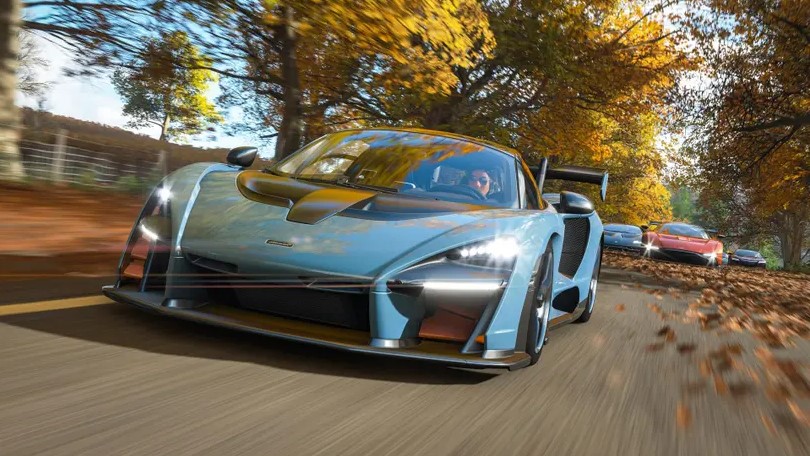
The game’s two core ideas, racing and crashing, are diametrically opposed to one another. Both are there and balance each other out to provide an entertaining experience throughout the game. Yet, they don’t work together to make the game better than what it is on paper: a racing title in which you sometimes marvel at some mangled collisions.
Several sorts of races in Hazardous Driving become available to you in a more or less linear fashion depending on the vehicle you drive (SUV, supercar, formula DD, etc.). The vast majority of challenges include some kind of racing, whether it’s attempting to drift hunters string together boosts in Heatwave, facing off against a single opponent in Face Off, or seeing how far you can travel before crashing in Survival. Of course, crashing into others is always a possibility, even if you aren’t particularly intent on doing so, such as when you are a police officer in Pursuit mode.
I got a kick out of plowing into oncoming traffic at breakneck speeds and witnessing the automobiles flip and disintegrate in a ball of fire. These moments are there in Dangerous Driving, but they aren’t cohesive enough with the racing to make the wrecks seem like anything more than a cheap chuckle. Even when I was responsible for sending another vehicle sliding, the slow-motion crash interludes irritated me and kept my mind off of the race. It’s hard to determine whether it’s you or them while you’re being hammered. The real-time nature of the race means that you might be anywhere on the track when you take someone out, which can be disorienting.
The first spectacle of the wrecks wears off quickly. Crashing is frequently unnecessary since the car’s performance may be improved in other ways, such as by obtaining air, drifting, or avoiding pileups. Other than the last lap or home stretch, it serves little use since in race-focused modes (multiplayer is planned for after launch), your opponents are back on the track in no time. Crashing becomes somewhat more exciting later in the game when events involve takedown criteria, such as having to completely wipe out an opponent utilizing just A.I. traffic. These restrictions make takedowns more difficult to achieve but do little to enhance the significance of the crashes.
The settings do not contribute to the chaos in any way other than the impending A.I. automobiles. While each course has its own unique set of scenery in the backdrop, the technique in which bends and straightaways are put together is same. Similarly, choosing a car isn’t a huge deal because each vehicle class has its own set of events, and while there are four different variants of each car class, each variant is optimized for a different race mode (Tuned vehicles are best for Heatwave races, for example), so there isn’t much room for strategic planning.
While Hazardous Driving includes a few problems, such as brief pauses in tunnels, infrequent unexpected vehicle swerves (both yours and the A.I. ), lag, and inconsistent accident judgments, these aren’t the main reasons why the game falls short. In previous games from developer Three Fields, such as the Danger Zone series and Dangerous Golf, the damage had a purpose; yet, in Dangerous Driving, I have been unable to uncover such a purpose. Insane levels of speed provide some excitement throughout the races, but the action and subsequent wrecks fail to leave a lasting impression.