

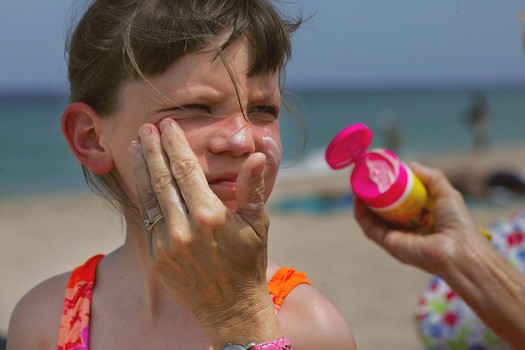
After a long and very cold winter, Canadians are finally enjoying some sunshine filled weather. And, if you have been to any drugstore or pharmacy in the last few weeks, you likely have come across a centrally located shelf stalked full of sunscreens. The names read off fairly typically: Banana Boat, Hawaiian Tropic, Ombrelle, etc. What you may not realize however, is that picking and buying just any sunscreen off the shelf may not keep your skin healthy and protected throughout the summer months. In fact, some sunscreens contain chemicals that can actually harm your skin, while others contain chemicals that are just bad for your overall health. Meanwhile other sunscreens might proclaim false , promises, advertising more protection than any sun screen could possibly deliver. For the last eight years the Environmental Working Group has been conducting research on sunscreens and releasing a yearly report where they investigate and look at all the ingredients and chemicals in the sunscreens along with their effectiveness for protecting the skin without causing other harm to the body. They also look into causes of skin cancer, which according to the National Cancer Institute is on the rise. They do this by studying research data as well as trends and sunscreen and skin care beliefs and usage. The following is a summer of some of their findings for 2014:
Skin Cancer is on the rise
As previously mentioned, the National Cancer Institute has reported that skin cancer is the one cancer on the rise, while many other forms of cancer have dropped slightly or remained constant in their numbers. The number of melanoma skin cancer cases(the deadliest skin cancer) has tripled since the 1970’s. Since the millennium the rates of melanoma cases has climbed to 1.6% per year. It has been found that Caucasian American men are the highest risk group to experience skin cancer, while white women are also at higher risk, especially compared to other racial groups. It has also been researched that people are being diagnosed with skin cancer at younger ages too. Some cases have even reported skin cancer in teenagers. At this rate it is very likely that those of us who live past the age of sixty five have a 40-50% chance of developing a skin cancer lesion. Although skin cancer is rarely a fatal cancer, it can be disfiguring and uncomfortable. There are a number of other risk factors the can contribute to an individual being more susceptible to skin cancer including:
1) A family history of skin cancer
2) The use of indoor tanning beds-which becomes worse or more likely to impact one the younger they have begun to use tanning beds( becomes worse especially if the person began using the tanning beds under 30 years of age).
3) The number of moles a person has on their skin
4) Having experienced a severe sunburn-the impact of this increases with the number of burns one has had in the past, and is also more likely to cause cancer if the person was quite young when they had the burn(s).
Can Sunscreen prevent skin cancer?
According to the Environmental Working Groups findings 61% of adults say that they do cover up and protect themselves from the sun. This seems to be supported by the fact that sunscreen sales are also way up, with stores generating an average of one billion a year annually from 2007 to 2012. Studies and research seems to be producing some mixed results and mixed messages as to whether sunscreen is actually helpful or not in preventing skin cancer. For example a study from 2011 found that when a group of Australians used an SPF sunscreen of 15 regularly throughout the year, and did other things to avoid the direct sunrays(such as wearing hats) they reduced their risk of developing melanoma(Green, 2011). Meanwhile several studies in the 1990’s seem to show that those who regularly wore sunscreen actually had an increased risk for developing melanoma(Autier 1998, Beitner 1990, Westerdahl 2000).
Some other confusing or interesting findings that seem to make one question the effect of the sun is that outdoor workers often have less melanoma than indoor workers. Researcher’s have also found melanoma cases to be higher in the Northern states and cities, compared to the Southern States and cities. In both cases this would suggest that the skin or the body develops an immunity to the sun or in other words that regular sun exposure is much less harmful to the skin than intermittent or high intensity sunlight exposure.
What the Environmental Working Group suggests is that sunscreen alone does not stop or reduce skin cancer. This goes against the F.D.A’s decision that allows sunscreen manufacturers to claim that sunscreen products prevent skin cancer. It is never the sunscreen alone that stops skin cancer, but more one’s whole attitude towards dealing with the sun. Certainly, some sun is good for the body, but one also needs to use some common sense when going out into the sun. The one problem with sun screen use is that some people become overly confident that they are protected from the sun and over stay their time in the sun when wearing sunscreen. Sunscreen can be an important part of practical sun protection, but it alone should not be the only factor. Common sense in avoiding the sun at peak times(between 11:30 a.m. and 3:30 p.m.) as well as wearing hats, t-shirts and U.V.B/U.V.A protective sunglasses and eyewear. It seems that even some of the food we eat may also affect the suns damage to the skin. Eating a diet high in Vitamin D has been shown to have some benefits in protecting the skin from the sun. Other foods that have been linked to protecting the skin from harsh rays include high antioxidant coffee and green tea as well as food high in lychopene (found in tomatoes and ketchup).
What to look for in a good quality and protective sun screen:
In the last eight years of reviewing sunscreens the Environmental Working Group has not seen a vast improvement in the quality of the mainstream marketed sunscreens. That is not to say that some of the smaller, lesser known companies have not made some impact on improving the quality of their sunscreens. This, coinciding with the fact that consumers have also been wanting answers and improvements has made some positive impacts on the products being manufactured, sold and purchased. Today there are now more companies with zinc and titanium dioxide sunscreens on the market. Still, only one third of the sunscreens on this seasons market made it onto the list of healthy sun protection without any hazardous chemicals. In total there was 149 beach or sport sunscreens approved on the E.W.G’s 2014 list of healthy sunscreens. The Environmental Working Group also has a list approving 62 skin Moisturizers with SPF. Another improvement that occurred in December 2012 is that the F.D.A. finally outlawed the ability to claim that sunscreen is “waterproof” or “sweatproof” , which of course is impossible. The F.D A. also stopped the selling and production of the less affective powdered sunscreens.
Unfortunately there are still several chemicals being added into many of the mainstream sunscreens being sold on the market today, along with false proclamations about sky high SPF’s. And although powdered sunscreens have been banned, many are still selling spray on sunscreens or towlettes for applying sunscreen. Here is what to look for when buying your next bottle of sunscreen:
1) Look for an SPF between 15-50. Less than a SPF of 15 provides little protection, and over fifty is highly unlikely to exist so it is a false promise or advertisement.
2) Stick to a sunscreen Lotion. Avoid sprays, which seem easier sometimes to apply, but give less coverage as one often misses areas without knowing. Also avoid sunscreen and bug spray combo’s as these two things often have little to do with each other, and often add an unnecessary high dose of chemicals to the skin. Sunscreens are more necessary during the middle of the day from roughly 10 a.m. to 4 p.m.. Meanwhile bug spray is more necessary first thing in the morning or early in the evening.
3) Avoid Sunscreens that contain Retinal Palmitate. This is a derivative of Vitamin A and is often used in anti-aging night creams, however it increases one’s sensitivity to the sun and can increase your chance of getting skin lesions and tumours.
4) Avoid sunscreens that contain Oxybenzone. This is a chemical that mimics estrogen and can cause a low birth rate to baby girls whose mothers are using the products. It has also been linked to endometriosis in older women.
5)Look for a sunscreen that has a broad spectrum. This means it protects equally for U.V.B. and U.V.A. rays. U.V.B. rays are the rays that can cause the skin to burn or blister. While U.V.A. rays penetrate much deeper than the skin, and the effect is often not as clear or obvious.
Source: ED Treatment India


