Author: Gundolf Meyer-Hentschel
The connection between medication and the risk of falls is well known. Psychopharmaceuticals and analgesics are frequently named as causative agents, antihypertensives more rarely. In 2015, there was even an article in the Ärztezeitung with the title: “Blood pressure reduction in seniors: higher risk of falls, my ass”. The PRISCUS 2.0 list for Germany contains eight “problematic” antihypertensives. But none of these preparations mentions an increased risk of falls as a reason. A recent English study now offers a well-founded analysis of the influence of antihypertensives on the risk of falls.
Conclusion
In frail patients over 80, positive effects and therapy risks (especially an increased tendency to fall) are approximately balanced in hypertension therapy. This is certainly true for patients who are prescribed an antihypertensive for the first time.
For physicians:
In elderly and frail patients, the benefits of lowering blood pressure with medication should be carefully weighed against the risk of possibly provoking a fall.
For caregivers in long-term care:
Residents receiving antihypertensive medications are at above-average risk for falls as they age and – especially – become frail. These residents should therefore be given special care with regard to fall risks.
The study
On April 19, 2023, a study was published that examined the risks of antihypertensive therapies. For this purpose, the health data of 3.8 million English patients (40 years and older) were available over a period of ten years. From these data, 484,145 patients were selected who had been prescribed an antihypertensive drug for the first time. Approximately 3.4 million patients who had not received medication served as a control group. All patients had a systolic blood pressure between 130 mm HG and 180 mm HG.
Results in detail
Fall events (hospitalization or death due to falls) were very rare under hypertension medication across all age groups: 3.1% of treated patients over a 10-year period. The comparable figure for the control group was 1.5%.
When age groups and physical fitness were considered separately, a differentiated picture emerged.
The older the patients, the greater the influence of medication on the risk of falls. For example, 12.2% of patients aged 80-89 who were prescribed antihypertensives for the first time suffered a fall resulting in hospitalization or death over the following 10 years. In the same age group without antihypertensive therapy, only 9.4% suffered such an event.
For clarity, another way of looking at it: In the patient group 40-49 years, there was only 1 additional fall event per 10,000 patients per year under the influence of medication compared with the control group. In the age group 80-89 years, antihypertensives led to 61 additional fall events (per 10,000 patients per year).
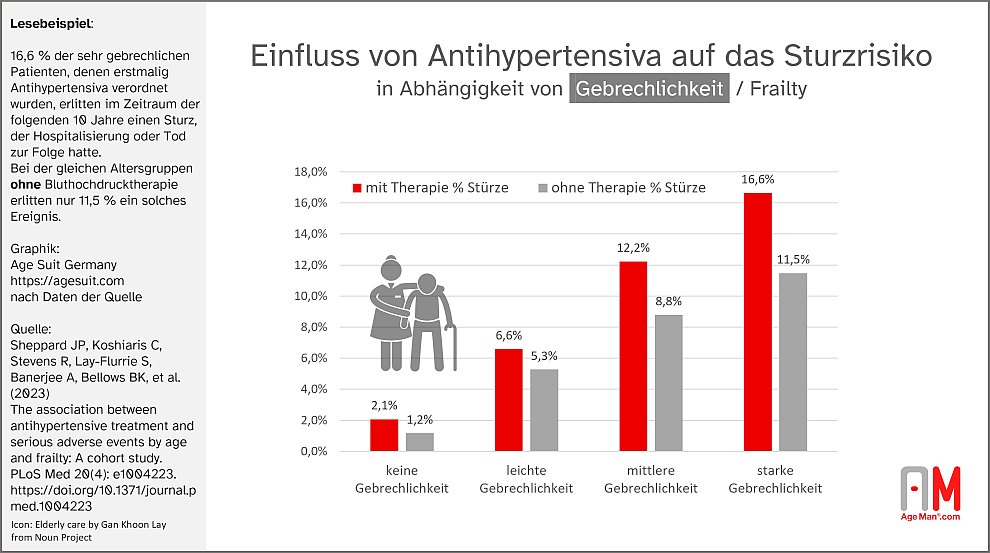
A comparable effect was observed when analyzing patient groups with different physical fitness: the greater the frailty at the start of therapy, the greater the influence of medication on the probability of falls. For example, 16.6% of very frail patients who were prescribed antihypertensives for the first time suffered a fall resulting in hospitalization or death during the following 10 years. In the same age group without antihypertensive therapy, only 11.5% suffered such an event.
Again, the absolute perspective: in the fit, nonfrail patient group, there were 5 additional fall events per 10,000 patients per year under the influence of medication compared with the control group. In very frail patients, antihypertensives led to 84 additional fall events (per 10,000 patients per year).
According to the study authors, this is the largest population-based analysis of the risks of antihypertensive therapy to date and the first to examine the influence of age and frailty.
Source
Sheppard JP, Koshiaris C, Stevens R, Lay-Flurrie S, Banerjee A, Bellows BK, et al (2023).
The association between antihypertensive treatment and serious adverse events by age and frailty: A cohort study. PLoS Med 20(4): e1004223.
More articles on falls in old age:
Global Falls Guideline 2023: https://agesuit.com/sturzrisikofaktoren-und-empfehlungen-zur-sturzprophylaxe-globale-leitlinie-2023/
Effects of age-related hearing loss on fall risk and gait pattern: https://agesuit.com/altersschwerhoerigkeit-sturzrisiko-gangbild/